Index of Key Research Articles

Below is an Index of Key Research Articles published by Suegnet Meyer and Meyer & Associates Sports Physiotherapists that are often referenced by clinicians and students in the fields of Physiotherapy/ Physical Therapy, Biomechanics and Sonography.

Copyright
All articles on this site are copyright © 2025 of Suegnet Meyer and Meyer & Associates Sports Physiotherapists. Transmission or reproduction of the contents, beyond that allowed by fair use as defined in the copyright laws requires the written permission of the copyright owners. Please provide proper attribution when referencing or sharing content.

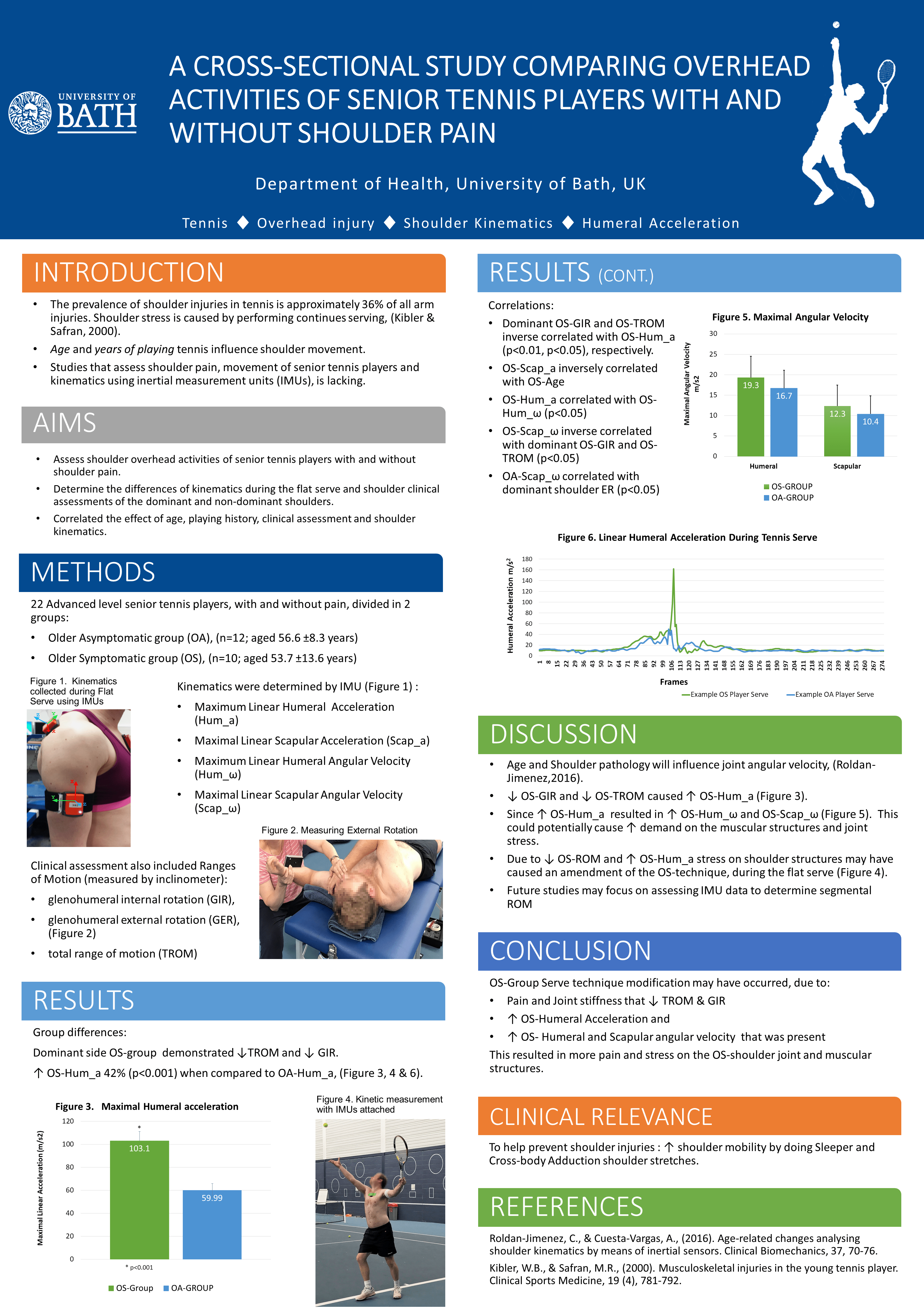
A Cross-Sectional Study Comparing Overhead Activities of Senior Tennis Players With and Without Shoulder Pain

Author: Suegnet Meyer, MSc BPHYST MCSP

Published: 7 June 2020

MSc Sports Physiotherapy Dissertation

University of Bath, 2018


Abstract

Study Design

Cross-sectional design

Background

Repetitive overhead activity during tennis is a causative factor of shoulder pain. Age and playing years will influence shoulder movement and possibly result in shoulder injuries for throwers and hitting athletes. Literature assessing the shoulder movements of senior overhead athletes with shoulder pain exist, but correlation with serve kinematics is lacking.

Tennis player with motion sensors attached
Objectives

This study compares the effect of shoulder overhead activities on senior tennis player – with and without shoulder pain. The differences between movement patterns by means of inertial measurement and shoulder clinical assessments were assessed and correlated with the effect of age and playing history.

Continue reading

Case Study: Diagnostic Ultrasound of Achilles Tendinopathy

How does Diagnostic Ultrasound Fit into the Physiotherapy Practice?

Author: Suegnet Meyer, MSc, BPHYST, PGCert MSK US.

Published: 6 June 2020


Copyright © 2025 of Suegnet Meyer. All rights reserved.

Slide 1: Non-insertional or Mid-portion Achilles tendinopathy: Does Diagnostic Ultrasound fit into Physiotherapy Practice?

How does Diagnostic Ultrasound fit into the  Physiotherapy Practice

This presentation was constructed as part of completing a postgraduate qualification in Musculoskeletal Sonography (PGCert MSK US) at Brunel University, 2020. This case study data has been anonymised and patient consent obtained.

Continue reading

Functional Movement Screening – Is it a Valid Injury Predictor in Sport?

By Suegnet Meyer

Functional movement screening (FMS) is a tool that consist of 7 tests. It is widely used by trainers, coaches and therapists to predict if an athlete is at risk of injury. Many have raised their scepticism regarding the true value of using these tests as injury predictor.

In a recent systematic review (Moran et al., 2017), documented that FMS composite scores prediction and injuries that occurred, did not correlate. ‘Moderate’ evidence exist  ‘against’ using FMS in football injury prediction. Limited and conflicting evidence exists in basketball, running, police and firefighters. Various cases were assessed and ‘strong’ evidence was found that a high FMS composite scores, predicting a high injury risk, only resulted in a small amount of injuries sustained in military personnel. Although FMS has good to excellent inter- and intra-reliability, it is advised not to base injury prediction on FMS, as it is inaccurate.

Reference:

Moran, R., Schneiders, R.W., Mason, J., Sullivan, S.J., (2017). Do Functional Movement Screen (FMS) composite scores predict subsequent injury? A systematic review with meta-analysis. British Journal of Sports Medicine. DOI:10.1136/bjsports-2016-096938

Effects of Back Pain on Overhead Hitting and Throwing

What effect does back pain have on the movement pattern of the upper limb and trunk during overhead hitting or throwing?

During throwing the thoracic spine influence the scapulo-thoracic position and glenohumeral motion. A thoracic kyphosis produce both abduction and protraction of the scapula and changes the orientation of the glenoid. This reduces the clearing space for the humeral head and increase anterior translation.

Thoracic rotation

Trunk pre-rotation towards the dominant side adds force that obliques externus may be able to generate increased force due to greater ROM. Counter-Clockwise Thoracic rotation limitation (for right handed pitchers in the late cocking phase) will reduce forward acceleration of the throwing arm Continue reading

Prevention and Rehabilitation of Thrower’s Elbow

1. What is Thrower’s elbow?

Medial or inside elbow pain may be caused by performing repetitive badminton overhead smashing. These forceful strokes cause inside elbow stress on the elbow (or medial valgus stress), (Fleisig et al., 1996), and may have the following consequences: golfer’s elbow (flexor-pronator tear or tendinosis), nerve irritation (ulnar neuritis), or Ulnar Collateral Ligament (UCL) sprains or ruptures, (Bell, 2006). This ongoing stress on the elbow causes further damage by overloading the bony elbow structures at the back and cause loose bodies and more instability Continue reading

Skiing

Management of ACL Ruptures in Skiers

Clinical Guidelines for the Management and Return to Competition of Professional Alpine Skiers Suffering from Anterior Cruciate Ligament (ACL) Rupture

Author: Suegnet Meyer

Introduction

Knee InjuryThe Anterior Cruciate Ligament (ACL) is the primary knee stabiliser that prevents anterior laxity of the tibia in relation to the femur and provides rotational knee stability (Negus et al., 2012). In the United States, approximately 200,000 Anterior Cruciate Ligament Reconstructions (ACLR) are performed annually at a cost of $3 billion (Brophy et al., 2009). Devastating evidence estimates up to 10% of professional alpine skiers will end their careers due to ACL ruptures or tears (Pujol et al., 2007).

Aim

This Clinical Guidance is aimed at Physiotherapists, Strength & Conditioning Coaches and Doctors to prevent and manage ACL ruptures during professional downhill, freestyle skiing and ski-cross during off-season. Continue reading

Quadriceps Dysfunction in Patello Femoral Pain Syndrome

Knee PainThere exists a lack of consensus determining the etiology of Quadriceps Dysfunction in Patello Femoral Pain Syndrome (PFPS). It is suggested that multifactorial causes for PFPS exist. For example: Quadriceps muscle mass can be reduced due to Vastus medialis atrophy causing Quadriceps strength deficiency or altered Quadriceps recruitment patterns. Abnormal activation patterns due to deficient neuromuscular imbalance causing Vastus lateralis to contract earlier than Vastus Medialis Oblique resulting in a lateral directed force on the patella and abnormal patella tracking has also been suggested. Thus abnormal activation patterns due to a deficient neuromuscular pattern has been considered. Continue reading

Spine Injuries in Sport

Author: Suegnet Meyer
Published: 8 Dec 2013

Introduction

This literature review looks at Cervical Injuries that occur during participation in sport. It looks at injuries that happen in sport with frequent impact, e.g. Rugby and American Football, and also injuries due to continuous strain induced by high G-forces, e.g. Motorsport, Bobsleigh and Skeleton.

Aims

The aims of this literature review are to establish: 1) Which muscles stabilise the neck? 2) Which Cervical Strengthening (CS) exercises are most effective? 3) Whether cervical strengthening is effective for rehabilitation and injury prevention? Continue reading