
Frozen Shoulder (Adhesive Capsulitis)
A frozen shoulder is one that has become painful and stiff to the point of being stuck. The capsule, which is the sleeve of tissue wrapping the joint, becomes inflamed and thickened. As it tightens, the shoulder loses movement. The medical name for this is adhesive capsulitis.
It usually appears between the ages of 40 and 60, and often there is no obvious trigger. It is more common in people with diabetes, and it can follow an injury, an operation, or any period when the shoulder has not been moving much.
What it feels like
Frozen shoulder tends to begin quietly, as an ache that builds over several weeks. Pain is usually the first thing people notice, and it is often worst at night, when lying on that side becomes impossible.

The stiffness comes later, and it is usually what brings people in. You may find you cannot:
- reach behind your back
- get your arm into a coat sleeve
- reach up to a shelf
- wash or dry your hair
- sleep on that side
The most telling sign is loss of external rotation, which means turning the forearm outwards with the elbow tucked in against your side. In a frozen shoulder this movement goes early, and it stays restricted whether you move the arm yourself or someone else moves it for you. That distinction is important, because it is how we tell a frozen shoulder apart from a shoulder that simply hurts too much to use.
How long does frozen shoulder last?
Frozen shoulder is often described in three phases. A painful freezing phase comes first, then a frozen phase in which the pain settles but the movement does not return, and finally a thawing phase as the shoulder gradually loosens.
In practice these phases blur into one another, and the timescale varies a great deal. Recovery can take anywhere from several months to a couple of years. Most shoulders do improve, though not all of them return completely to normal, and waiting it out is poor advice for anyone who cannot sleep, drive or work. Treatment aims to shorten the painful phase and protect movement while it passes.
How frozen shoulder is diagnosed
Frozen shoulder is a clinical diagnosis. It is made from the history and from examining how the shoulder moves, both when you move it yourself and when we move it for you. The pattern of restriction is distinctive enough that an experienced examiner can usually recognise it.
Where ultrasound helps
A scan will not diagnose a frozen shoulder on its own. What it does is check everything else.
A stiff, painful shoulder can also be a rotator cuff tear, calcific tendinopathy, an inflamed bursa or advanced arthritis, and more than one of these can be present at the same time. Diagnostic ultrasound allows us to look at the tendons, bursa and joint directly, in the room, while the shoulder moves.
This is important because the treatments are different. A calcific deposit is treated with barbotage, whereas a contracted capsule is not.
An X-ray or MRI is occasionally worth arranging, particularly if the findings do not fit the picture, if there has been a significant injury, or if another cause is suspected.
How frozen shoulder is treated
What is appropriate depends on where you are in the condition and how irritable the shoulder is. A shoulder in the painful early phase is managed differently from one that has settled but remains stiff.
Physiotherapy and exercise
Movement is the foundation of treatment, but it has to be pitched correctly. Forcing a hot, painful frozen shoulder into aggressive stretching tends to make it angrier without achieving much, and it is a common reason people arrive here having already tried physiotherapy and found that it made things worse.
Early on, the aim is to control pain and gently maintain the range you still have. Later, as the shoulder tolerates more, the work shifts towards restoring movement and rebuilding strength. Specialist physiotherapy is how that progression is judged and adjusted.
Steroid injection
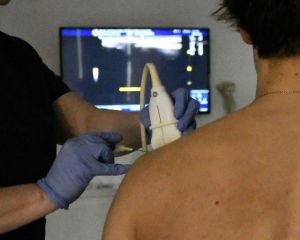 An ultrasound-guided steroid injection, sometimes called a cortisone injection, into the shoulder joint can be effective when pain is the dominant problem, particularly in the early phase.
Placement is important. The injection needs to reach the glenohumeral joint itself rather than the space above it, and the two are easily confused without imaging. Every injection at Meyer Physio is performed under live ultrasound guidance, so the needle and the medication are watched onto the target.
Relief from pain also makes it possible to begin or progress rehabilitation, which is often the greater benefit.
Hydrodilatation
Where stiffness rather than pain is the limiting factor, hydrodilatation may be considered. You may also see it called hydrodistension, or spelled hydrodilation. These all describe the same procedure.
Fluid, usually combined with local anaesthetic and a steroid, is carefully injected into the shoulder joint under ultrasound guidance to gently stretch the tightened capsule. The aim is to reduce pain and improve movement, particularly when stiffness is holding back rehabilitation.
Not every frozen shoulder needs it. Whether it is the right step depends on how stiff the shoulder is, how long it has been going on, and what has already been tried.
Treatment is followed by a programme of exercises. The procedure creates a period in which the shoulder can move more freely, and rehabilitation is what turns that into a lasting improvement.
Do I need a scan or an injection?
Not necessarily. The first task is to establish whether this is a frozen shoulder at all, and whether anything else is contributing. That is an assessment rather than a procedure.
If a scan or an injection is the right next step, we will explain why, what it involves and what it is likely to achieve. If it is not, we will tell you that too.
What it costs
Every appointment lasts a full hour. Where a diagnostic scan is needed, the appointment is charged at the scan rate, which replaces the standard consultation fee rather than being added to it.
Current prices for assessment, scanning and ultrasound-guided injections are listed on the prices page. No GP referral is needed to book.
Frozen shoulder assessment in Weybridge
Meyer Physio is an advanced practice physiotherapy and MSK diagnostic clinic on Baker Street in Weybridge. Assessment, diagnostic ultrasound and ultrasound-guided injection all take place in the same room and the same appointment, with no waiting list.
Written by Suegnet Meyer, Advanced Practice Musculoskeletal Physiotherapist and MSK Sonographer. HCPC registered [PH55635]. Chartered Society of Physiotherapy member [66175].