
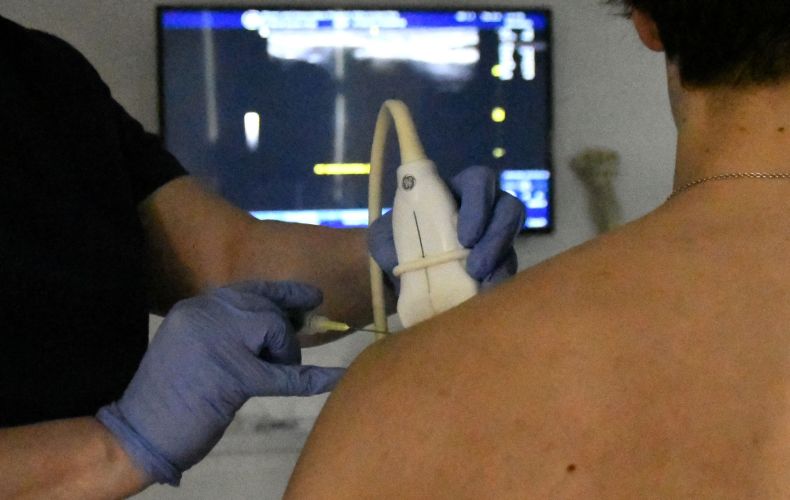
Ultrasound-Guided Injections
When pain stops you sleeping on that shoulder, gripping a kettle or getting back out running, a well-placed ultrasound-guided injection can be the thing that breaks the cycle and lets rehabilitation start.
Getting there begins with knowing exactly what is wrong. At Meyer Physio in Weybridge, your first appointment is a full hour of assessment, with a diagnostic ultrasound scan where that will help. You leave understanding what we found and what we recommend — not with a referral to somebody else and a wait to find out.
Why use ultrasound guidance?
An injection only helps if the medication reaches the structure that is actually causing your pain.
Many injections are still placed by feel, using anatomical landmarks — an estimate of where the target usually sits. Ultrasound replaces the estimate with a picture.
During an ultrasound-guided injection we can:
- identify the intended joint, bursa, tendon sheath or other structure
- assess the surrounding anatomy before inserting the needle
- identify nearby blood vessels, nerves and tendons
- watch the needle as it approaches the target
- see the medication being delivered to the intended area
- adapt the approach when your anatomy makes that necessary
This matters most in small or deep structures, and wherever important nerves, blood vessels or tendons lie close to the target.
Ultrasound guidance offers greater procedural precision and, for some musculoskeletal injections, has been associated with improved short-term clinical outcomes compared with landmark-guided techniques.
Who performs the injections?
Every injection at Meyer Physio is carried out by Suegnet Meyer, an Advanced Practice Musculoskeletal Physiotherapist and MSK Sonographer.
Suegnet spent two years working in an NHS radiology department, developing her diagnostic ultrasound and injection therapy practice, and has been performing ultrasound-guided injection therapy since 2019. The imaging expertise came first and the injection technique was built on it, which is the order that makes guidance work — a guided injection is only as accurate as the clinician reading the screen while the needle moves.
The same clinician carries out your assessment, performs your scan, gives the injection and then manages your aftercare and rehabilitation.
That continuity matters. The reasoning behind your diagnosis, what the scan showed, why that particular injection was chosen and what should happen next all stay with one person. If your response is not what was expected, whoever reviews you already knows the case. And because the injection is planned as one step in a rehabilitation programme rather than as a procedure in isolation, what follows it has been thought about before it is given.
Assessment comes first
An injection should not be performed simply because an abnormality has been found on a scan.
Before recommending one we consider your symptoms, clinical examination, previous treatment and any relevant imaging. Changes seen on ultrasound do not always cause pain, so the findings have to match your symptoms and examination.
Not everyone who comes to us for an injection needs one. Where physiotherapy, further imaging, medication, more time or a specialist opinion would serve you better, we will say so and explain why.
Where an injection is the right next step, we go through what it involves, what it is likely to achieve and what the risks are, and give you the written information and consent form to take away. The injection is arranged once you have had time to consider it — deciding on a procedure is not something to do in the last five minutes of an appointment. If you already have a confirmed diagnosis, or you are returning for a repeat procedure, it can often be arranged sooner.
Available injections
- Ultrasound-Guided Steroid Injections — precisely targeted steroid, sometimes called a cortisone injection, to reduce inflammation and relieve pain in joints and soft tissue structures.
- Hyaluronic Acid Injections — lubricating injections for osteoarthritic joints, to improve movement and reduce discomfort.
- Cingal® Injections — hyaluronic acid and a steroid combined in a single injection, giving both rapid and longer-lasting relief.
- Arthrosamid® Injections — a hydrogel injection for knee osteoarthritis, for long-lasting relief of pain and stiffness.
- Joint and Soft Tissue Aspirations — removal of excess fluid from swollen joints to relieve pressure and support diagnosis.
- High-Volume Injections — used in the management of persistent tendinopathy.
- Hydrodilatation — fluid-based injection used to stretch a tight joint capsule, particularly in frozen shoulder.
- Barbotage — breaking down and flushing out calcium deposits in calcific tendinopathy, restoring movement and reducing pain.
Local anaesthetic may be used during some procedures. As well as making the injection more comfortable, it can be informative in its own right: if temporarily numbing a particular structure changes your familiar pain, that helps confirm where the pain is coming from.
Conditions treated with ultrasound-guided injections

- Shoulder impingement and rotator cuff tendinopathy
- Frozen shoulder (adhesive capsulitis)
- Calcific tendinopathy
- Shoulder osteoarthritis
- Tennis elbow and golfer’s elbow
- Hip bursitis and gluteal tendinopathy
- Hip osteoarthritis
- Knee osteoarthritis
- Ankle osteoarthritis
- Achilles and patellar tendinopathy
- Plantar fasciitis
- Morton’s neuroma
- Carpal tunnel syndrome
- Trigger finger
- Thumb base osteoarthritis (CMC joint)
- Big toe osteoarthritis
- Wrist pain
- Persistent musculoskeletal pain
What happens during an ultrasound-guided injection?
The procedure is explained beforehand and you will have the chance to ask questions.
The area is examined with ultrasound and the safest, most appropriate approach is chosen. The skin is cleaned with an antiseptic solution and a sterile, no-touch technique is used. The needle is then introduced under ultrasound vision and guided towards the intended target, and medication is injected or fluid aspirated depending on the procedure.
Most musculoskeletal injections are quick, and you can usually leave the clinic shortly afterwards.
Are ultrasound-guided injections painful?
Most people tolerate ultrasound-guided injections well. You will feel the needle entering the skin, and some pressure or discomfort as the medication goes in.
Some areas are naturally more sensitive than others, and we will explain what to expect before we start.
What are the risks?
Musculoskeletal injections are generally well tolerated, but no injection is completely without risk. The risks depend partly on the medication and the area being treated, and can include:
- temporary pain, or a post-injection flare
- bruising or bleeding
- infection
- changes to skin colour or fatty tissue around the injection site
- temporary changes in blood glucose, particularly in people with diabetes
- allergic or medication-related reactions
- tendon injury where injections are performed close to certain tendons
- temporary numbness or weakness where local anaesthetic is used
Individual procedures may carry additional risks. Before treatment we review your medical conditions, medications, allergies and anything else that could affect whether an injection is appropriate, and we discuss the expected benefits, the alternatives and the relevant risks before you decide to go ahead.
After your injection
Aftercare depends on the type and location of the injection. We generally advise avoiding strenuous activity involving the injected area for a short period, which does not usually mean complete rest. You will be given advice specific to your procedure and told when to return to exercise or rehabilitation.
Some people are sore for a short time after an injection before symptoms start to improve. Response to a steroid injection varies — some people improve substantially, others gain little benefit.
Injections and physiotherapy
An injection is rarely the whole treatment plan.
For most musculoskeletal conditions, physiotherapy, exercise and progressive rehabilitation remain central to longer-term management. An injection may open a window of reduced pain that lets you move more comfortably and make progress with rehabilitation. The aim is not simply to perform an injection, but to know where it fits in your overall treatment.
What does it cost?
The injection fee covers the medication, the sterile consumables and delivery of the injection under ultrasound guidance. Current fees for assessment, scans and each injection are listed on our prices page.
Written by Suegnet Meyer, Advanced Practice Musculoskeletal Physiotherapist and MSK Sonographer. HCPC registered [PH55635]. Chartered Society of Physiotherapy member [66175].
Last reviewed: 9 September 2026.