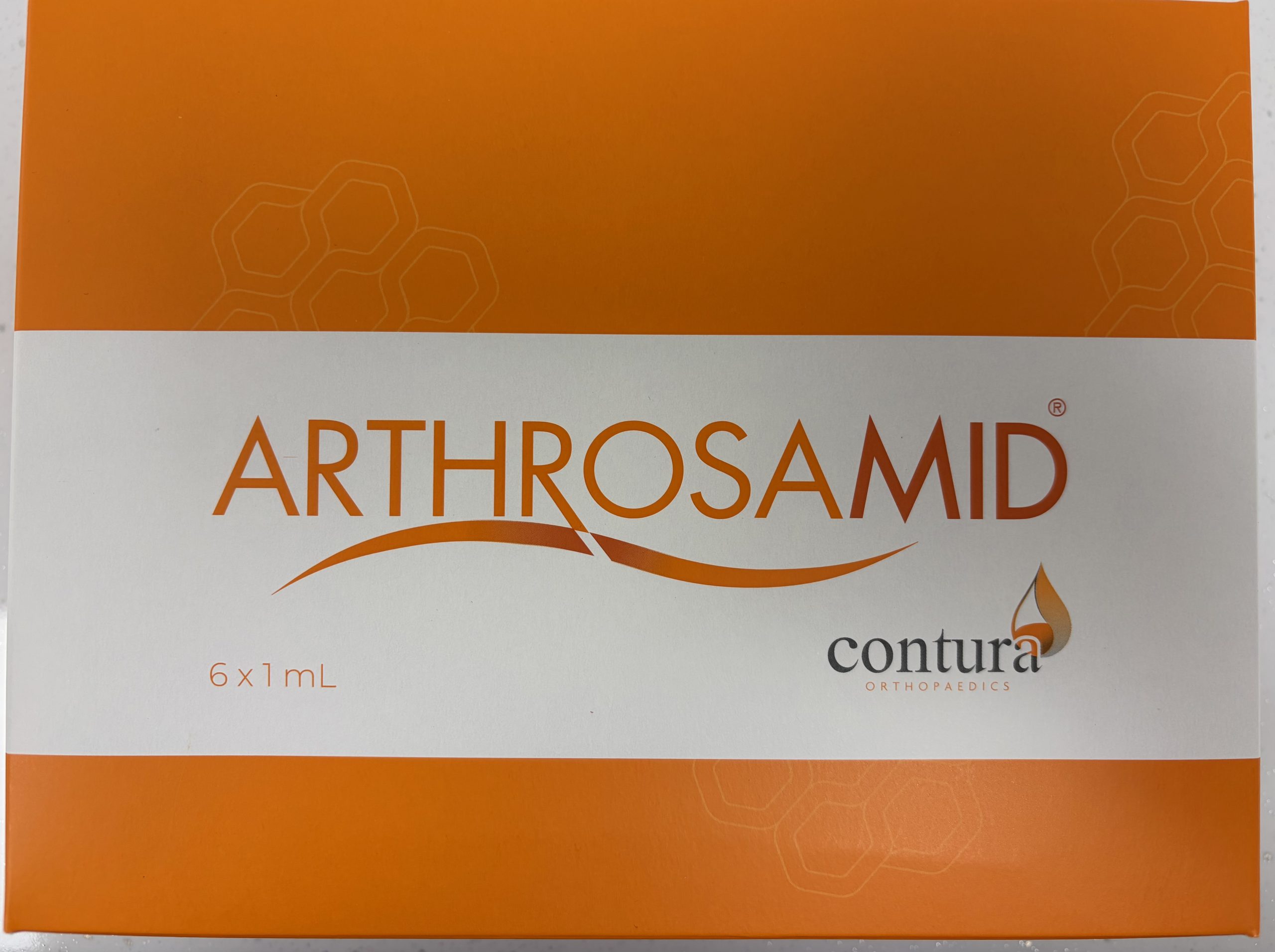
Arthrosamid Knee Injection

Long-lasting relief from knee osteoarthritis – without surgery

Knee osteoarthritis narrows your life gradually. Stairs, the dog walk, standing at the sink, getting out of a low chair — each becomes something to plan around. For many people the next thing offered is a knee replacement, and not everyone is ready for that.

Arthrosamid is a single hydrogel injection that relieves knee osteoarthritis pain, reduces stiffness and restores function, without surgery. Meyer Physio is an approved Arthrosamid clinic, offering it privately in Weybridge, Surrey.

Arthrosamid logo

What Is Arthrosamid?

Arthrosamid hydrogel knee injection at Meyer Physio, WeybridgeArthrosamid® is an advanced, long-lasting injectable hydrogel designed to relieve knee osteoarthritis pain without the need for surgery. Made from 97.5% water and 2.5% cross-linked polyacrylamide, it offers long-lasting relief from a single injection — considerably longer than is typically seen with alternative treatments such as hyaluronic acid or Cingal injections.

It integrates with the joint lining, known as the synovium, enhancing lubrication, cushioning the joint, and reducing inflammation to improve comfort and mobility.

Why Choose Arthrosamid?

Knee osteoarthritis pain treated with Arthrosamid in Weybridge

  • Lasting Relief – Benefit from a single injection, with clinical studies showing effects lasting up to three to five years.
  • Non-Surgical – Outpatient procedure with no hospital stay or downtime.
  • Clinically Proven – The polyacrylamide hydrogel technology is backed by over 20 years of research.
  • Delays Surgery – May help to delay knee replacement.
  • Excellent Results – 70–75% report a significant improvement in symptoms; up to 50% describe it as “life-changing”. For more on results and outcome studies, see the Arthrosamid website.

How Does Arthrosamid Work?

Knee osteoarthritis leads to cartilage breakdown and inflammation in the synovial lining of the joint.

Once injected, Arthrosamid:

  • Bonds with the joint lining to create a soft, cushioning barrier
  • Enhances lubrication within the joint
  • Reduces synovial inflammation and associated pain
  • Improves joint function and mobility

What to Expect

Step 1 – Consultation

Your clinician will assess your knee and determine whether Arthrosamid is suitable for you.

Step 2 – Injection

You will be given antibiotics about an hour before your Arthrosamid treatment to protect you from any potential risk of infection.Ultrasound guided knee injection

To ensure the hydrogel is delivered to the precise location in the joint, we always perform ultrasound guided injection therapy.

Local anaesthetic is used to numb the area, and the hydrogel is then injected directly into the knee joint in a single, one-step procedure.

Step 3 – Aftercare

Mild discomfort may occur once the anaesthetic wears off. We’ll advise you on post-treatment care and symptoms to monitor, though side effects are rare.

The clinician who assessed your knee and gave the injection is the same one who sees you afterwards, so your follow-up carries on from the treatment rather than starting again with somebody new.

Is Arthrosamid Right for Me?

It may be a good option if:

  • You have knee osteoarthritis that’s no longer responding to physiotherapy, exercise, or standard pain relief
  • You want to avoid or delay surgery
  • You’re seeking a long-term solution with minimal disruption to your lifestyle

Private Arthrosamid treatment in Weybridge

This treatment is not routinely funded on the NHS, so it is provided privately on a self-pay basis. We are an approved Arthrosamid clinic and carry out the assessment, the ultrasound-guided injection and your follow-up in Weybridge, so there is no onward referral to another provider and no waiting list.

Your first appointment is a full hour of assessment. Where Arthrosamid is the right option we explain what it involves, what it is likely to achieve and what it costs, and arrange the treatment once you have had time to consider it.

Frequently Asked Questions

How soon will I feel the results?

Most people start noticing improvements around 4 weeks post-injection.

Does the injection hurt?

Local anaesthetic is used to numb the area first, and most people tolerate the procedure well. You may feel pressure as the hydrogel goes in, and the knee can be mildly sore for a few days afterwards. Tell us at any point if you are uncomfortable.

How long does Arthrosamid last?

Clinical studies show benefits may last up to three to five years from a single injection.

What is the recovery time?

This is an outpatient procedure with no hospital stay and no significant downtime. Mild discomfort is common once the local anaesthetic wears off. You will be given specific aftercare advice at your appointment, and the Arthrosamid patient rehab booklet below sets out the exercise guidance that follows treatment.

Are there any side effects?

Side effects are rare. The most common is temporary discomfort or swelling around the knee in the days after the injection. Antibiotics are given about an hour beforehand as a precaution against infection. We will go through the risks with you at your consultation and tell you what to watch for afterwards.

Can I still have knee replacement surgery later?

Yes — Arthrosamid doesn’t interfere with the possibility of future knee surgery.

Can I receive Arthrosamid treatment in both my knees?

Yes, it is possible to have both knees treated with Arthrosamid but your clinician is best placed to decide the time period before the treatments. Please contact us for a discounted price for treatment of more than one joint.

How much does Arthrosamid cost?

It is provided as a single treatment package. Current fees are on our treatment pricing page, and a discounted price applies where both knees are treated.

Where can I get more information?

If you have any questions about this treatment or would like to know whether it’s suitable for you, feel free to get in touch with Meyer Physio by phone or email. You can also explore the patient brochure and leaflets linked below, or the official Arthrosamid website for further information.

Arthrosamid Brochures

To learn more about the Arthrosamid treatment, download a patient brochure or patient leaflet from the Arthrosamid website below:

  • Arthrosamid® Patient Brochure
Download
[Link verified 21/08/2026]
  • Arthrosamid® Patient Leaflet
Download
[Link verified 21/08/2026]
  • Arthrosamid® Patient Rehab Booklet
Download
[Link verified 21/08/2026]

* Arthrosamid®, the Arthrosamid logos and images are copyright Contura International Ltd.

Book Your Arthrosamid Consultation Today

If you’re ready to take the next step in managing your knee pain, we’re here to help. Contact us to discuss your treatment or book your assessment consultation at Meyer Physio in Weybridge.

📞 Call us: 07736 731 022

📧 Email: enquiries@meyerphysio.com


Written by Suegnet Meyer, Advanced Practice Musculoskeletal Physiotherapist and MSK Sonographer. HCPC registered [PH55635]. Chartered Society of Physiotherapy member [66175].
Last reviewed: 10 September 2026.

Joint Aspiration & Soft Tissue Aspiration

What is a Joint Aspiration or Soft Tissue Aspiration?

An aspiration is performed by using a thin needle to take some of the fluid out of the joint or affected soft tissue. This procedure, also known as arthrocentesis, is one of the most common Injection Therapy procedures used for muscle and bone problems. Joint Aspiration is mostly done at the knee or shoulder.  A soft tissue haematoma may indicate a soft tissue aspiration.

When will a Joint Aspiration or Soft Tissue Aspiration be necessary?

If a joint is swollen, a sample of joint fluid (synovial fluid) can help to find the cause of swelling. A sample of the fluid may be tested to find out whether, for instance, it contains bacteria  or abnormally high levels of white blood cells.

In some cases, the excess fluid (effusion) causes pressure and pain. By removing some of the fluid during the aspiration will help to reduce pain and promote healing.  Aspiration may also be used as a treatment, to reduce the pressure on the joint or soft tissue.

How is an aspiration performed?

The clinician uses the syringe to remove the excess fluid. If needed, medication can be injected into the joint during joint aspiration.

Special preparation is usually not needed. The surrounding skin is carefully disinfected beforehand to keep germs from entering the joint. The clinician wears sterile disposable gloves during the procedure to avoid any infection. Sterilized disposable cannulas and syringes are unpacked right before use.

The clinician can use diagnostic ultrasound to locate the position where the aspiration is required. Diagnostic ultrasound is sometimes used to monitor the entire procedure. A local anaesthetic may be used, if required.

A pressure bandage is often applied after the procedure. The joint itself usually needs to be kept still – how long will depend on the cause of the swelling and whether medication was injected during the aspiration.

Is it painful? 

Joint aspiration typically feels a bit like having blood drawn.  Depending on the type of aspiration, a local anaesthetic may be used.

What happens after the procedure and what should I look out for?

Afterwards it is important to watch carefully for signs of inflammation. If the joint or puncture site are red, swollen or start feeling very warm, you should inform your clinician immediately. Other warning signs include fever and worsening pain.

What are the risks involved?

There may be bleeding in the joint or soft tissue, afterwards. Inflammation at the needle insertion site is possible. If medication is injected as well, it may cause a feeling of pressure or a short burning sensation. The medication might have side effects such as allergic reactions too. Anti-inflammatory drugs can lead to facial redness, increased blood pressure, a racing heartbeat and flushing.

The greatest risk is that of an infection caused by germs that have managed to get in. This risk varies depending on what is done during the aspiration and which joint is involved. Diabetes or a weakened immune system increase the risk of infection.

Where can I find out more before considering the procedure?

Please contact us: suegnet@meyerphysio.com

Hyaluronic Acid Injections for Arthritic Joints

Hyaluronic acid injection, also known as viscosupplementation, is a pain-relieving treatment for osteoarthritis, and is most often used where the joint changes are mild to moderate. It can be used in almost any arthritic joint. The knee is the most common, but the same treatment is used in the shoulder, hip, ankle, the small joints of the hand and thumb, and the big toe.

Biolevox hyaluronic acid injection used at Meyer Physio, WeybridgeDurolane hyaluronic acid injection for knee osteoarthritis

What is hyaluronic acid?

Hyaluronic acid is a naturally occurring substance found in the synovial fluid of your joints, where it acts as a lubricant and a cushion. In a joint affected by osteoarthritis those natural levels are depleted, and an injection supplements them.

Why have a hyaluronic acid injection?

The aim is to lubricate and cushion the joint, reducing pain, improving how the joint moves, and potentially delaying the need for more invasive treatment such as surgery. It is an option where joint pain persists despite rehabilitation and simple pain relief.

Which joints can be treated?

Almost any osteoarthritic joint can be considered. In practice the most common are:

  • Knee osteoarthritis, the most frequently treated joint
  • Shoulder osteoarthritis
  • Hip osteoarthritis
  • Ankle osteoarthritis
  • The small joints of the hand, including the base of the thumb
  • The big toe

Which hyaluronic acid do you use?

We use Durolane, Synvisc One and Biolevox. Durolane is the one we use most often. Which product suits you is decided at your appointment, once the joint has been scanned and assessed, and depends on the joint being treated, the state of the joint and how you responded to any previous injections.

How long does a hyaluronic acid injection last?

This depends on the product. Durolane (Bioventus) is a single injection that works for up to 26 weeks. Some other hyaluronic acid preparations are given as a course of injections over a few weeks rather than as one.

Other options for an arthritic knee

Two related treatments may also be considered. Cingal combines hyaluronic acid with a steroid in a single injection, so it can settle inflammation quickly as well as lubricating the joint. Arthrosamid is not a hyaluronic acid at all but a hydrogel, given as one injection and intended to last considerably longer.

How is the injection done?

The injection is given in clinic as an outpatient procedure, and hyaluronic acid is injected directly into the joint through a fine needle.

Like all injections at Meyer Physio, it is placed under live ultrasound guidance, so the medication reaches the joint space itself rather than the tissue around it. That makes the injection more accurate and more comfortable than one placed by feel, and in small joints such as the thumb or the big toe it is what makes an accurate injection realistic at all.

How effective is it?

Results vary between individuals. Some people get significant pain relief and noticeably better joint function; others benefit less. It is worth having realistic expectations and discussing the likely outcome for your particular joint before going ahead, which is part of what the assessment appointment is for.

Side effects

Common side effects are temporary pain or swelling at the injection site. Infection and allergic reactions are rare. Tell us about any allergies or medical conditions before the procedure.

After your injection

Avoid strenuous activity involving the treated joint for about 24 to 48 hours afterwards. You will be given specific post-treatment instructions at your appointment.

What does it cost?

The fee covers the medication, the sterile consumables and delivery of the injection under ultrasound guidance — there is no separate charge for the guidance. Current fees are on our treatment price list.

Informed Consent

Please follow the link: Informed consent for hyaluronic acid injections

Book Your Assessment Today

If osteoarthritis pain is limiting you and you would like to know whether a hyaluronic acid injection would help, contact us or book an assessment at Meyer Physio in Weybridge. We scan the joint, explain what we find and agree the right treatment in the same appointment.

📞 Call us: 07736 731 022

📧 Email: enquiries@meyerphysio.com


Written by Suegnet Meyer, Advanced Practice Musculoskeletal Physiotherapist and MSK Sonographer. HCPC registered [PH55635]. Chartered Society of Physiotherapy member [66175].